Newsletter are published three times a year, in April, August and December. The following newsletters are available online:

To view the Newsletters as PDF files (no 54 onwards), you will need Adobe Reader software or similar.

No. 32 – December 1998

Council News

Council met on the 26th of October at the Education Department of the British Museum. The Secretary reported on an invitation from the Society for Medieval Archaeology, asking Council to send, once a year, a representative to their own Council meetings. The MPRG is happy to accept this invitation in principle although none of the Council members present could easily attend the meeting in question. We do welcome this approach from the Society and look forward to future fruitful co-operation.

Most of the meeting was, as ever, taken up with the report from the Editorial Committee; their projects and responsibilities seem neverending. At present the editors are finalising Medieval Ceramics 21, beginning Medieval Ceramics 22, taking orders for the Guide and clearing the decks for publication of the Minimum Standards document. It is therefore perhaps fortunate that progress on the anticipated Occasional Papers on Ipswich Ware and Trondheim Redwares has slowed, for it seems the Editors have enough on their plates as it is! The delays in producing Medieval Ceramics were discussed by Council. It seems the introduction of refereeing has unavoidably slowed the process but we are of the opinion that deadlines for contributions must be set and stringently applied, even at the risk of publishing a slimmer volume than usual.

A draft of the Minimum Standards document was submitted to Council. It was agreed that this should be circulated for comment among the regional groups of MPRG and if you are interested in seeing it a copy should soon be with your regional groups secretary. It is hoped that the finished document will be published and circulated with Medieval Ceramics in May 1999.

Anne Jenner provided a report on the forthcoming conference in Sheffield and you should find a preliminary programme with this Newsletter. It looks as like this will be a very interesting meeting and I, for one, am very much looking forward to exchanging views with specialists in other periods.

Chris Cumberpatch, the Regional Groups Officer, raised the issue of those recommendations arising from the Mellor Report that might be addressed at a local level. It was felt that regional groups could be involved in setting up lists of important collections and sites and that this might stimulate activity in some groups which have been rather quiet in recent years. Further details will appear in the Newletter.

Finally, Council discussed plans for the next AGM. The President, Secretary, both Editors, the Assistant Editor and one ordinary member are standing down, which leaves a large hole in Council. It is customary for the President to invite somebody to take over as his successor, although that post, as well as all the others, is available for anyone who wishes to stand. The greatest problem is losing the editorial team. Jacqui Pearce may stand for one of the Editor’s posts and Council considered that, in the event that nobody offered their services, the other Editor’s post might be filled by co-opting one of the present incumbents for a year. This would have the effect of staggering the terms of office for the Editors, thus avoiding the five-yearly problem of losing both of them at once. It is hoped that the membership are sympathetic towards this plan.

The next meeting of Council is on the 10th February 1999; if there are any matters you wish me to raise, please contact me.

Duncan H Brown, Secretary


Medieval Ceramics

The proofs for volume 21 of Medieval Ceramics are being finalised at present (it will probably be just over 100 pages), and the editorial team hope the journal will be out by early next year. It is planned that volume 22 will be shorter but will appear in time for the meeting in May next year at Sheffield. There is still time for short contributions to the Compendiario for volume 22.

Mike Hughes, Co-Editor


Minimum Standards

for the Processing, Analysis, Publication and Archiving of Post-Roman Pottery

As a result of the survey of medieval ceramics (Mellor 1994), the MPRG took on board the need to produce nationally agreed minimum standards for those working with medieval pottery. The other ceramic period groups have all published guideline documents of their own (Fulford & Huddlestone 1991; PCRG 1991; PCRG 1992).

Over the past year an MPRG working party has been working on the production of a draft document. It will include a broad summary, outlining general principles, which it is hoped can be agreed by all three ceramic period groups. The draft document is now ready for circulation among the wider MPRG membership. All regional group organisers have been circulated with a copy. Please contact them if you would like to see one (for the name and address of you regional group organiser, contact Chris Cumberpatch, Regional Groups Officer).

All comments should be sent to me by Christmas, or as soon afterwards as possible, to: Anna Slowikowski, Bedfordshire County Archaeology Service, St Mary’s Church Archaeology Centre, St Mary’s Street, Bedford MK42 0AS, tel 01234 270009.

References

  • Fulford, MG and Huddleston, K. 1991, The Current State of Romano-British Pottery Studies, a review for English Heritage. Occasional Paper No. 1.
  • Mellor, M. 1994 Medieval Ceramic Studies in England, a review for English Heritage.
  • PCRG 1991 The Study of Later Prehistoric Pottery: general policies. Occasional Paper No. 1.
  • PCRG 1992 The Study of Later Prehistoric Pottery: guidelines for analysis and publication. Occasional Paper No. 2.

Regional Group Meetings

SEMPER

The spring 1998 meeting was held at St Albans Museum, on the theme of Hertfordshire Greyware and related types; over 20 people attended! There is no autumn meeting, but a joint session with the East Midlands and Anglia Roman Pottery Research Group is planned for Saturday 6th February 1999, at Aylesbury Museum, to discuss the differences and similarities in our ways of working with ceramics, and the general need for minimum standards. This will also be an opportunity to discuss the draft MPRG standards document, although, as all comments should be in by the New Year, please don’t wait till this meeting if you would like to contribute.

For further details of this meeting, or if you would like to go on the mailing list, please contact Anna Slowikowski (see above, Minimum Standards, for address).

NWMPRG

Unfortunately the planned NWRMPRG meeting for June had to be postponed. It is hoped that a meeting will be held in the New Year. Anyone interested in being placed on the group’s mailing list should contact Julie Edwards, c/o Chester Archaeology, 27 Grosvenor St, Chester CH1 2DD.


Ceramics and related courses

Handling session: decorated medieval floor tiles

An opportunity to handle medieval floor tiles from Guildford Museum’s collection, including material from Chertsey, Guildford, Merton, Newark and Waverley. The session will be repeated on two days, 13th-14th February 1999, at Salter’s, Guildford Museum’s Annexe, Castle Street, Guildford. Cost is £5, including light refreshments, a glass of wine and a talk. The displays will continue as a public exhibition until 20th February. Applications for tickets should state which day you will attend, and enclose a cheque payable to Guildford Museum. For further details contact Guildford Museum, Castle Arch, Guildford, Surrey, GU1 3SX, tel 01483 444750/444752.


Meetings and Conferences

British Archaeological Association Meetings 1999

We have been asked to advertise the following series of lectures, which are all held in the rooms of the Society of Antiquaries of London, Burlington House, Piccadilly, London W1V 0HS, with tea from 4.30pm and meeting from 5pm. Non-members welcome, but should contact the Hon Director, Philip Lankester, beforehand (details deleted on request).

  • 6 Jan. ‘The grand amorial stove and “Turkish Bath” at the Palace of Whitehall’, David Gaimster.
  • 3 Feb. ‘Timber importation to the British Isles and its uses in medieval times’, Gavin Simpson.
  • 3 Mar. ‘Louis d’Orleans (1372-1407) and the sculptured images of the Nine Worthies’ Julia Watson.
  • 7 April ‘Unspeakable Architecture; or the terminology of Gothic’, Alexandrina Buchanan.
  • 5 May ‘Romanesque wall painting in England and Scotland: discoveries and research since 1990’ David Park.

Majolica and glass: from Italy to Antwerp and beyond. The transfer of technology in the 16th-early 17th century.

This conference will be particularly concerned with workshops for the production of luxury tablewares established by Italians in Antwerp, and the diffusion of this technology to other regions in North-Western Europe. The place of majolica and glass within the broader setting of the 16th century economic and social developments and processes will also be considered. Material from excavations in Antwerp will be on display and there will be poster displays and space for material brought by delegates. Papers will be presented in English and French. The conference will take place in Antwerp on 3rd–5th June 1999, and the fee will be approximately 1500 BEF. For further information, or to offer a poster, contact Stad Antwerpen, Archeologie, Godefriduskaai 36, B-2000 Antwerpen, Belgium, tel/fax +32 3 232 9208.


Experimental Firing in Suffolk

The occasion for this firing was a weekend of archaeology at Priory Farm, Preston St Mary in Suffolk to celebrate the 150th year of the Suffolk Institute of Archaeology. On the final day we had invited the public to view our excavation and this seemed as good an excuse as any for a pottery firing. Several years of digging on an adjacent 13th–14th century site had yielded a considerable quantity of pottery, so we had plenty of examples to inspire us when it came to making our pots. Most, but not all, of the pots we put into the kiln were made from clay dug on the farm. It has to be said that the chalky boulder clay subsoil in this part of Suffolk is a potter’s clay of last resort, but I did find an area of brown clay which was free of chalk. This actually threw very well. However, it was rather short and seemed to lack elasticity in drying. This caused jug handles to break or come off. It is interesting that local medieval handles tend to be straight and stay close to the pot. Perhaps they, too, were trying to minimise this problem.

We chose to model our kiln on a late medieval example excavated at Rickinghall in the north of the county (see Medieval Ceramics 20 for report). This unusual kiln had firemouths at each end and a chamber in the middle, and measured 3.5m long and 1m across. We scaled this down to suit our quantity of pots. Gilbert Burroughes, the kiln builder, had to work very fast since we could not start building before Friday morning and it had to be ready to fire at first light on Sunday. For this reason, he supported all of the structure except the dome of the firing chamber with soft red bricks which were then covered with a particularly sticky example of our yellow clay, well stamped up with straw. The pots were then piled in and straw placed over them and the clay dome formed over the top. Four holes were cut for flues and a pyrometer inserted in the side. The kiln with the pots was gently heated late on Saturday evening.

The firing on Sunday went well and a temperature of 980°C was reached around tea-time. This, bearing in mind that the kiln was still fairly wet, was good. The two firemouths worked fine and gave plenty of scope for enthusiastic amateurs to try their hand at stoking. When several days later we opened it up, we were disappointed to find a high proportion of breakages. I think putting the raw pots in a new kiln overnight was probably the reason for our losses. The good news is that all the pots were grey to dark grey and very well fired, even if some suffered fairly drastic warping. In medieval terms they were quite usable, so we can be said to have achieved our aim.

Adrian Thorpe, Priory Farm, Preston St Mary.


The MPRG website and email

To publicise pottery events on the website, contact Paul Miles, c/o Oxford Archaeological Unit, Janus House, Osney Mead, Oxford OX2 0ES, tel 01865 243888.

Other email addresses can be found on the website.

Other interesting ceramics websites:

• www.ceramique.com: mainly an art site, but with a bookshop which includes some archaeological material. In French, some English.

• www.cma.ab-c.nl: the website for the Corpus Middeleeuws Aardewerk series on ceramics in the Netherlands and Flanders. In English and Dutch.


New Books

L’Innovation Technique au Moyen-Age

P Beck (ed), Actes du Vie Congrès international d’archéologie médiévale (Dijon 1996), 336 pages, 290F.

Information from Les Informations de L’Association Bourguignonne de Recherches Céramiques newsletter, which highlights Chapter 5, ‘De l’amélioration du quotidien’, including ‘Tupins et tupiniers, la production potière en Val-de-Saône du Vie au XIIe s.’ by Y Petitdent and E Poil; ‘L’apparition des glaçures plombifères et stannifères: exemplaires français’ by C Hanusse, M Leenhardt, N Meyer-Rodriguès and L Vallauri; ‘Les grès médiévaux: évolution ou révolution?’ by A-M Flambard-Héricher; ‘Tradition et innovation dans la céramique consommée à Tours au Bas-Moyen-Age et à l’époque moderne’ by P Husi. Available from Epona, 7 rue Jean du Bellay, 75004, Paris, tel +(0)1 43 26 40 41.

Les poëles en céramique au Moyen-Age et à l’Epoque moderne

Annick Richard and Jean-Jacques Schwein (eds), Actes du colloque sur la céramique du poële (Montbéliard, 1995), 256 pages, 8 col. plates, many B&W illustrations, c250F. Supplement à la Revue Archéologique de l’Est.

About 15 articles providing a fundamental contribution to the knowledge of this particular type of ceramic, with marked sociological connotations. Available soon from UMR 5594, Faculté des Sciences, 6 bd Gabriel, 21000 Dijon, France. Tel. +(0)3 80 39 57 97.
No. 40 – August 2001

Secretary’s Notes

Council met at the Museum of London on 21st June, with a full agenda of editorial and conference matters amongst others. The editorial committee remain as busy as ever, despite the successful appearance of the Minimum Standards document (for details of how to obtain this publication, see elsewhere in this Newsletter). Work will now proceed on the joint Minimum Standards document (in conjunction with the Prehistoric Ceramics Research Group and the Roman Pottery Group). Volume 24 of Medieval Ceramics is well advanced, with all but one paper received and reviewed. This volume should, all being well, be published towards the end of this year.

The Edinburgh conference proved most successful, making a profit of about £500; a short report on the proceedings, and the AGM, appears below. Arrangements for our 2002 conference in Dublin are progressing well, many thanks to Clare McCutcheon who has set up the venue (Trinity College) and a tempting array of exhibitions, viewings and social events. The dates will be 2nd-4th September, so get it in your diary now. And for those members who may perhaps feel that two ‘long-distance’ conferences in a row are not practicable, plans are afoot to organise a one-day meeting in London in the spring next year, with a provisional theme of ‘Redwares and Slipwares’. More details will be available nearer the date. It has yet to be decided where next year’s AGM will be held.

The response from higher education institutions to Alejandra Gutierrez’s questionnaire on ceramics teaching/ research has been very positive, and a high proportion of the 40 selected institutions (those dealing with medieval pottery, or which have MPRG members on the staff, or which have a ceramic background) have replied. Most university archaeology departments have at least some modules where medieval pottery could fit in, but it is currently only taught if there is an appropriate specialist on the staff. This is where the second part of the survey comes in – the survey of expertise amongst MPRG members – but response to this has been poor, only about 25 replies out of about 200 circulated (UK) members. The aim is to provide information to universities on who might be useful specialists to contact, and to collect data on who is doing research, and where (there are currently only two recorded PhDs in medieval pottery). So if you haven’t yet filled in your questionnaire, please spare a little time to do so if you can.

Finally, we are happy to announce that our vacant Council posts have been filled: Victoria Bryant (formerly Buteux) has accepted the post of Vice-President and, subsequent to the Council meeting, Liz Pieksma has agreed to stand as an Ordinary Member. As neither were elected at the Edinburgh AGM, these posts will be co-opted until they can be confirmed at the next AGM.

The next Council meeting will be held on Thursday 18th October; if you have any comments or wish to raise any issues please contact me before then.

Lorraine Mepham, Secretary


AGM Report

The 2001 AGM was held at the Edinburgh conference, and was (just) quorate. Despite our best intentions, yet again we found ourselves squeezed into an inadequate time-slot, and this has to hold the record for the quickest AGM on record – I clocked it at 20 minutes.

There was, needless to say, little time for discussion, and the reports from the various officers were very briefly presented. Most of this information had already been discussed at Council meetings and has therefore already been summarised in the past year’s Newsletters, apart from the Treasurer’s report. Bob Will reported a healthy bank balance, but an income which was not currently keeping pace with expenditure. One answer to this is to raise subscriptions, and it was agreed at the meeting that this should be done; Council will be discussing the new rates before proposing them at the next AGM.

The publication of Occasional Paper No. 2 (the Minimum Standards document) was announced – a preliminary box had arrived hotfoot from the publishers in time to make it onto the conference bookstall. Otherwise the only other item of any note came from our President, Clive Orton, who announced that he had just been promoted to Professor, along with two of his colleagues. The meeting offered well-deserved congratulations and a bottle of champagne.

Lorraine Mepham, Secretary


Annual Conference 2001 – Edinburgh

This year’s conference was held over a weekend in May at the City Arts Centre in Edinburgh, an unimaginably distant location for those of us miserable southerners who feel unsafe north of Watford. For those of us who braved the crossing of Hadrian’s Wall, however, the event was well worth the effort. This was billed as an ‘old-style’ conference, with an emphasis on pottery viewing and plenty of time for discussion. And this we certainly got on the Sunday, with the whole day devoted to the examination and discussion of a large display of pottery from Edinburgh and other sites in Scotland, in which the local redwares and white gritty wares appeared alongside a wide range of imported wares. The day’s main objective was to identify as many of the imports as possible, and to discuss the best means of publishing them.

This is to jump the gun, however – the conference began on the Friday evening with a reception and a lecture by George Haggarty on the development of the Scottish ceramic industry in the Edinburgh region. This was a fascinating introduction to the subject but, by his own admission, merely scratched the surface of an industry which is still imperfectly understood – there is clearly the potential here for much future research, both archaeological and documentary.

Saturday was filled with papers, most of which concerned the recent research into the two major Scottish medieval ceramic industries: Redwares and White Gritty Wares. Each type was evidently made at many different locations, and sourcing thus depends largely on scientific analysis. Two pilot studies, on the two respective industries, have so far been undertaken in conjunction with the British Geological Survey, and funded by Historic Scotland. George Haggarty, Derek Hall and Bob Will gave the background to these pilot studies, and Dr Simon Chenery of the BGS gave two presentations on the results, which have proved the potential of scientific analysis to aid the definition of source areas within each industry. Overall this was an excellent example of how well thought-out strategies to answer specific problems in ceramic research have led to targeted analysis and successful results – a lesson for others contemplating similar problems. It was also extremely encouraging to hear the comments made by Olwyn Owen (Historic Scotland), which were very supportive of the current research taking place in Scottish ceramic studies.

A conference wouldn’t be a conference without the socialising, and a number of us enjoyed a splendid meal at the Marlin’s Wynd restaurant, in some impressively restored vaults close to the Royal Mile, while others elected to sample the Edinburgh nightlife.

So congratulations and many thanks to George Haggarty, Bob Will and Charlie Murray for organising such an enjoyable conference, and to all the others who helped behind the scenes; here’s to the next Edinburgh event!

Lorraine Mepham, Secretary


MPRG Conference 2002 – Dublin, 2nd-4th Sept.

All members are encouraged to attend the conference next year. The conference centre is Trinity College, right in the centre of Dublin and close by The National Museum of Ireland, The National Library, The National Gallery, The Natural History Museum, The Dail (Parliament), several outstanding book shops and plenty of shopping!

Accommodation has been pre-booked for c40 in Trinity itself at an approximate cost of câ50 euros B&B per night (approx £40 stg). Remember that as of 1 January 2002, Ireland’s currency will be the euro, and all payments must be in that currency. I would be very much obliged if members who are definitely coming could give me an indication so that I can adjust the accommodation if possible. There will be a limited number of double rooms for couples but the balance will be single rooms on their own or within apartments. There will also be suitable accommodation in hotels etc near Trinity.

As the conference lectures are firmed up I will let the members know what is happening but there will be a broad appeal in the lectures and much of interest to our members, and hopefully the wider archaeological community in Ireland in order to allow for some interaction beween us all. The third day will be dedicated specifically to pottery including lectures and viewing of some of the material housed in the National Museum of Ireland’s stores. As this is the central location for all artefacts in the Republic of Ireland there will be much to interest our members.

Clare McCutcheon


Regional Groups

SEMPER

6th October, Aylesbury

The SEMPER meeting to be held at West Stow has been postponed until next Spring, so the next SEMPER meeting will be at the somewhat more reliable venue of Aylesbury Museum. The theme is to be announced, but part of the day will probably involve a discussion of ceramic type series.

For further details, Anna Slowikowski, tel 01234 270009.

NWMPRG

6th October, Liverpool

The next NWRMPRG meeting will be on Saturday 6th October 2001. The products of the Buckley potteries in Flintshire, Wales will be the topic for the day which will be hosted by Liverpool Museum at their store in Liverpool. For further information please contact Julie Edwards, c/o 27 Grosvenor Street, Chester CH1 2DD.


Meetings and Conferences

Finds Research Group AD700-1700

4th – 5th November, Dublin

The FRG Autumn meeting will be held in Dublin. This is a two-day conference. One day is devoted to the Viking to early medieval transition in Ireland focusing on Dublin, and the second day will concentrate on the medieval to post-medieval transition in England.

For further information contact: Quita Mould, Eastmoor Manor, Eastmoor, Kings Lynn, Norfolk. PE33 9PZ, tel 01366 328910.

Society for Medieval Archaeology: Town and Country 1100-1500

12th-14th April 2002, York

Organised by the Society for Medieval Archaeology, to be held at the University of York. Themes include: inhabiting the medieval town and countryside; producing and consuming in town and country; urban landscapes: landscape archaeology and towns; powers, beliefs and mentalities. Contact Kate Giles, Dept of Archaeology, University of York, King’s Manor, York YO1 7EP.

Medieval Europe 2002

10th-15th September, Basel, Switzerland

The theme of next year’s conference is ‘Centre – Region – Periphery’. There are eight themes, which are as follows:

  • Cultural regions, economic areas
  • Innovation, communication, interaction
  • Sovereignty and territory
  • Structure and topography of the ruling power: Identity and demarcation
  • Settlement in inhospitable regions
  • The Regio TriRhena
  • New studies of medieval and later archaeology in Europe (poster session)

The detailed programme and the (final) registration forms will be sent out in Autumn 2001 to all who have enrolled by 1st October 2001 via email, fax or post. Contact Medieval Europe Basel 2002, c/o Archaeologische Bodenforschung, Petersgraben 11, PO Box CH-4001 Basel, Switzerland. Fax +41-61-267 23 76, web www.mebs-2002.org.


Teaching pottery

Alejandra Guttierez would still like to hear from members who are interested in teaching medieval pottery at their local university or other educational establishment. She intends to contact university archaeology departments with a list of potential tutors very soon. If interested, please contact her at Dept of Archaeology, University of Durham, South Road, Durham DH1 3LE.


MPRG Standards

The MPRG Minimum Standards for the Processing, Recording, Analysis and Publication of Post-Roman Ceramics is now available, and a flyer whould be enclosed with this newsletter.

Price: £4.50 + £1.00 postage and packing.

Order copies from: MPRG, c/o Museum of London Specialist Services, Mortimer Wheeler House, 46 Eagle Wharf Road, London, N1 7ED.

Note: If you bought a copy at the conference, please print an addendum sheet from the MPRG website.

No. 31 – August 1998

Newsletter No. 31 – August 1998

Council News

Council met at the British Museum on the 24th June. The president opened the meeting by welcoming new Council members and officers. He also expressed concern at the delays we have suffered in the appearance of Medieval Ceramics and the Guide to the Classification of Medieval Ceramic Forms. All of us on Council are aware of this problem and working hard on behalf of the Group. We will try to improve but in the meantime we hope that the Group’s membership will continue to be patient.

The Secretary reported little other than the usual enquiries. The Treasurer announced that he has found an auditor for the accounts, who was adopted by Council in accordance with the arrangement made at the AGM. The accounts remain healthy.

The report from the Editorial Committee was as full as ever. They have conducted a post-mortem on the ‘Guide’, highlighting the problems encountered in production. One unfortunate effect of these problems has been to force us to raise the price of the ‘Guide’ to cover unexpected outlay. Those of you who saw the pre-publication copy at the London meeting will know that it is worth every penny! Progress on two other occasional papers is slow. English Heritage have asked for more analytical work to be done on Ipswich Ware and Lyn Blackmore has returned to Norway to try and finish off her work on the Trondheim redwares. It is hoped, however, that our Minimum Standards for the Processing and Publication of Medieval Pottery will be available soon for consultation by the membership. The target date for publication of Medieval Ceramics 21 is September. The Committee, and especially the editorial team, have put in a lot of hard work and received deserved thanks from the President.

The report from our new Meetings Secretary concentrated on next year’s conference which will be a two-day meeting with the Prehistoric Ceramics Research Group (see below). The Roman Pottery Research Group have also been invited but had not responded. It was suggested that we rotate between a few fixed venues for future one-day meetings, as attendance at these has been so variable. London, Birmingham and Sheffield were suggested as three easily-accessible places and meetings would be held at each of these in turn, every other year. This would have the advantage of making organisation smoother and allowing the Meetings Secretary to concentrate on the three-day conferences that are held in alternate years. I would be interested to know what the Membership feels about the towns that have been suggested.

Alan Vince reported that the English Heritage Implementation Committee has not met for some time. This was set up to see through the recommendations of the Mellor report but is now at rest. It is perhaps now the responsibility of the Group, particularly through the Regional Groups, to address the remaining recommendations. Chris Cumberpatch, as the new Regional Groups Officer, was given the task of reviewing the recommendations and considering a way forward.

A number of suggestions for the celebration of the Group’s 25th Anniversary, in the year 2000 were put forward from the new working party. These ranged from the production of postcards and a booklet to excavating a pottery kiln. Council considered all these excellent suggestions and is looking forward to working towards a great celebration.

Finally, it was agreed that since Audrey Gahan is no longer a member of MPRG, Claire McCutcheon be invited to act as Irish representative to Council.

The next meeting is on the 21st October, if there are any points any of you want to raise, please write to me.

Duncan H Brown, Secretary


MPRG Conference 1999

Building bridges: a multidisciplinary approach to ceramic studies

The MPRG annual conference will be held at Sheffield over two days in May 1999.

The aim is to promote collaboration and discussion across regional, chronological and institutional boundaries and stimulate fruitful dialogue. Delegates and speakers will be encouraged from prehistoric, Roman and medieval interest groups.

Lectures will broadly cover processing and interpretation of ceramics from deposition to final publication. Specific areas of discussion will focus on cross-regional fabric studies; fabric archives; minimum standards of processing; methods of interpretation including formation processes and skeuomorphs; and new methods of communication using the internet and virtual reality.

Visits will be arranged to view relevant sites and ceramics.

Anyone wishing to contribute please contact Anne Jenner (or leave a message) on 01207 529553 or 0191 281 6251.


Medieval Ceramics

All individual members should by now have received a copy of Medieval Ceramics Volume 20. If not, please contact us.

Volume 21 of the Journal is currently undergoing final editing and proofs of part of it have already been printed. It should be out in the near future.

Volume 22 is in preparation and several papers have been submitted. However, the editors would like to hear from anyone who has either a full paper or, particularly, a short paper for inclusion in the Compendiario section, as very few of the latter have been submitted in recent years. Contact the Editors care of the British Museum.


Regional Group Meetings

NW Region

The NWRMPRG held a meeting last December to discuss recent work in the north-west and to consider holding regular meetings once more. It was a useful day, it was good to see pottery and people from various parts of the region. People had the opportunity to examine Manx granite tempered ware, groups of medieval pottery found in Lancaster and Chester as well as kiln material from Cheshire. A talk was given on the collections held by Liverpool Museum and a progress report on the National Bibliography was also given.

It was decided to hold meetings every six months or so. It is hoped that the next meeting will be in Lancaster this summer. The meeting will provide the opportunity to examine kiln material from Silverdale and Docker as well as to have a closer look at more recently excavated medieval pottery from Lancaster. Unfortunately, this meeting may already have been held by the time you receive this. Ed.

If you would like to be on the Group’s mailing list, please contact Julie Edwards, c/o Chester Archaeology, 27 Grosvenor Street, Chester CH1 2DD.

Regional Groups Liaison

Chris Cumberpatch has recently taken over from Beverley Nenk as Regional Group Liaison Officer. He would like to receive any news about future meetings or activities organised by regional groups. Contact him at 22 Tennyson Road, Lower Walkley, Sheffield S6 2WE, tel/fax 0114 231 0051.


Meetings and Conferences

European Association of Archaeologists

The 1998 EAA Conference, on 23rd-27th September 1998, will have three main themes, one of which is ‘Archaeology and material culture: interpreting the archaeological record’. This will include sessions on such diverse topics as: Wining and dining; the archaeology and social history of the Table in post-Roman Europe; Urban archaeology; The archaeology of wealth, prestige and value: processes and dynamics; Interpreting cultural identities in the archaeological record; Spatial analysis: landscape and material culture; Landscape and settlement archaeology; and Burial analysis – new approaches. There are several others, so send for details now! The final programme is due at the end of August. Further details from Dept. of Archaeology, Gutteborg University, Box 200, SE-405 30 Gutteborg, Sweden, tel +46 31 773 5181, (fax 5182), email EAA 98, web www.hum.gu.se/~arkeaa.

Finds Research Group AD700-1700

The Autumn meeting of the FRG will be on the theme of ‘Riding into the Past’ and will be spent examining aspects of horse riding and horse equipment. It will be held at the Friends meeting House, Worcester on 26th October 1998. Further details from Derek Hurst, tel 01905 611086.

FRG membership is still only £3 (£5 overseas). Contact Katey Banks, The Potteries Museum, Bethesda Street, Hanley, Stoke-on-Trent ST1 3DW, tel 01782 202173, fax 01782 205033.

Majolica and glass: from Italy to Antwerp and beyond. The transfer of technology in the 16th–early 17th century.

This conference will be particularly concerned with workshops for the production of luxury tablewares established by Italians in Antwerp, and the diffusion of this technology to other regions in North-Western Europe. The place of majolica and glass within the broader setting of the 16th century economic and social developments and processes will also be considered. Material from excavations in Antwerp will be on display and there will be poster displays and space for material brought by delegates. Papers will be presented in English and French. The conference will take place in Antwerp on 3rd-5th June 1999, and the fee will be approximately 1500 BEF. For further information, or to offer a poster, contact Stad Antwerpen, Archeologie, Godefriduskaai 36, B-2000 Antwerpen, Belgium, tel/fax +32 3 232 9208.

7th International Conference on Mediterranean Medieval Ceramics

Advance notice for this mid-October 1999 conference, to be held in Thessalonika. There are three main themes: ‘Between East and west: Byzantine ceramics of 5th-15th centuries’, ‘Centres of production and modes of commercialisation’, and ‘Mahgreb between East and West’. General interest papers and posters will also be welcome. For further details, contact AIECM2, 10 rue Mazarine, 13100 Aix-en-Provence, France, tel 04 42 52 43 08, fax 04 42 52 43 78. The email is apparently temporarily unavailable.


Ceramics courses

Early prehistoric pottery

18-25.8.98. Contact: Department of Continuing Education, Rewley House, 1 Wellington Square, Oxford OX1 2JA, tel 01865 270360.

Prehistoric pottery

19-20.9.98. Contact: Centre for Continuing Education, University of Sussex, Educational Development Building, Falmer, Brighton BN1 9RG, tel 01273 678527.

Iron Age and Roman pottery

3.10.98. Contact: Kent Archaeological Field School, School Farm Oast, Graveney Road, Faversham, Kent ME13 8UP, tel 0181 747 3683.

Editor’s note: If you are running a course like these, please let me know so that it can be included for the benefit of less experienced members.


Exhibitions

European Exhibitions 1998

The newsletter of the Association Bourguignonne de Recherches Ceramiques contains listings of no less than 24 exhibitions with ceramic themes (mostly post-medieval) which are on show in France and Italy this year. Examples include ‘Le pot de chambre en faïence’ at Badonviller; ‘Céramiques architecturales: céramiques dans ma ville,céramiques dans ma vie’ at Dieulefit (until end August); ‘Terres d’industrie’ at Creusot (until October); and ‘Un gout d’Italie: céramiques et céramistes italiens en Provence du Moyen-Age au XXe siecle’ at Fréjus (to 1st October). Those producing published catalogues are also noted, together with costs and contact addresses. The newsletter also lists several recent French and other European publications.

For a copy of the newsletter (No. 20, June 1998), which is sent out three times a year, write to Jean Rosen, ABRC, c/o Musee archaeologique, 5 rue Dr Maret, 21000 Dijon, France, tel/fax 03 80 53 61 71. Subscription costs 130F.

Shoji Hamada: Master Potter

Ashmolean Museum, Oxford, August 1998.

A loan exhibition of the work of this influential Japanese artist (1894-1978). Universally recognised as one of the century’s greatest masters of the craft, he worked with Bernard Leach in establishing the pottery of St Ives in the 1920’s.

Tiles from East and West

Ashmolean Museum, Oxford, November 1998 to January 1999.

This special exhibition is a unique collaboration by the Departments of Eastern Art, Western Art and Antiquities at the Ashmolean Museum. It brings together tile art from 8th century BC Mesopotamia through to 19th century industrial England, touching along the way the Roman Empire, the Islamic world including Spain, Northern French influences on the medieval English paving tile, Renaissance Italy and Dutch tin glaze tiles.

There will be a study day on Tuesday 24th November to explore the cross-cultural splendours of the three collections. A rich programme includes lectures by museum staff and specialists in the morning, and a handling session in the afternoon, looking at Islamic, Renaissance and English Delft tiles, offering participants a chance to follow influences and compare styles and materials. Further details from The Ashmolean Education Service, Beaumont Street, Oxford OX1 2PH. Cost £18. Limited to 36 participants.

Art and Culture of the Carolingian Period

An exhibition will be held in Paderborn, Germany, in 1999 to mark the 1200th anniversary of an alliance between Charlemagne and Pope Leo III which was negotiated in the latter’s palace at Paderborn.

According to the publicity material, this meeting in 799 was a momentous event which changed the spiritual and political landscape of Europe. The international exhibition which will be held to celebrate it, will include aspects of the art, culture and history of the period. It will run from 23rd July to 1st November 1999, and will take place in several museums and galleries across the city. Archaeological material, works of art, jewellery, illuminated manuscripts, historical documents and architectural models will be on display. Themes will include the Saxon Wars and Frankish territorial expansion in the late 8th century, 9th century settlement in Westphalia, the concept of imperial rule, ecclesiastical art and architecture, and art and liturgy in the Carolingian period. Objects and artefacts will be loaned from major collections in Germany, Italy, France, England and the USA. Further information from Ausstellung 799 GbR, Markt 17, D-33098 Paderborn, Germany, tel +49(0)5251 125-400, fax 125-495, email erzb.pb.mus@t-online.de


The MPRG website and email

The MPRG has a temporary page courtesy of Paul Miles’ website. It contains a copy of the information in the newsletter, information on joining the group and purchasing its publications, and lists of other relevant websites and ceramic groups. You can visit it at www.pmiles.demon.co.uk/mprg/mprg.htm.

The site also lists email addresses for several Council members. Information for the newsletter can now be sent by email (see below for my address), and anything which needs publicising between newsletters can be advertised on the web page.

Contact Paul Miles, c/o Oxford Archaeological Unit, Janus House, Osney Mead, Oxford OX2 0ES, tel 01865 243888.


A Guide to the Classification of Medieval Ceramic Forms

This first occasional paper has now been published, so pre-publication prices are no longer applicable. New prices and details now online.


New Books

Les Faïenceries de l’Auxerrois.

Camille Pellet
éditions de l’Armançon, 1998, 128 pages, 130 illustrations, 195F.

The first large study of this material takes a global approach, using archive research, archaeological material, scientific analysis and inventories of public and private collections.

No. 30 – April 1998

Council News

Council met on the 11th February at the British Museum. The meeting was somewhat disjointed, with the railway ‘network’ conspiring to delay the President for over an hour. Prominence was given to a discussion of the second draft of Minimum Standards for the Processing, Recording, Analysis and Publication of Post-Roman Pottery submitted by our working party. It was time that Council collectively considered the recommendations put forward in this document, as previous consultation had been on an individual basis. The discussion was very interesting and productive as we went through each section of the “Standards”. I don’t want to give anything away, nor run the risk of misrepresenting the finished article, but I am sure that this draft is close becoming a very useful document. You will all have a chance to comment in the near future through the regional groups network.

Much of the remainder of the meeting was taken up with the report from the editorial committee. There have been profound delays with the production of last year’s Medieval Ceramics and also with the Guide to the Classification of Medieval Ceramic Forms. The Editors have been working very hard on both these publications and they reported good progress, but there have been unavoidable problems which have now been resolved. The Editors are reasonably certain that the latest Medieval Ceramics will be out as usual in late Spring. The decision to referee the articles submitted to the journal has had the effect of slowing down production but the system is now in place and hopefully all will run smoothly from now on.

The remainder of the meeting consisted of the usual reports from Officers and arrangements for the AGM, which are included in this mailing. The next Council meeting is set for 24th June; if you have any comments or wish to raise any issues please write to me.

Duncan H Brown, Secretary


MPRG Annual Conference 1998

Don’t forget! Our annual conference, this year a one-day meeting on the theme Pottery in England 900-1200 AD, will be on Saturday 16th May at the Museum of London Interpretation Unit, London Wall, 9.30am-5.30pm.

Applications should be returned by 30th April. If you can’t find your leaflet, contact Victoria Buteux, Hereford and Worcester County Archaeological Unit, Tolladine Road, Worcester WR4 9NB, tel 01905 458608.


Regional Group Meeting

SEMPER

The Spring meeting of SEMPER will be held in May/June at Verulamium Museum and will be on the subject of Hertfordshire Greywares, courtesy of Alison Turner-Rugg. For further details (available nearer the time) contact SEMPER coordinator Anna Slowikowski, Bedfordshire Archaeology Service, St Mary’s Archaeological Centre, St Mary’s Street, Bedford MK42 0AS, tel 01234 270009.


Meetings and Conferences

Society for Post Medieval Archaeology and Northern Ceramic Society Joint Conference

A three day meeting will be held in Stoke-on-Trent on Friday 24th to Sunday 26th April 1998, on the subject of Recent work in ceramic history and archaeology. Cost £55 for members of either society, £65 for non-members, reductions for students, accommodation extra.

Further details from David Barker, Archaeology Section, City Museum and Art Gallery, Hanley, Stoke-on-Trent ST1 3DW, tel 01782 232323.

Finds Research Group AD700-1700

The Spring meeting of the FRG will be on the theme of Religious sites, religious artefacts. It will be hosted by Guildford Museum on 27th April 1998. Finds from Newark Priory and other Surrey religious establishments will be on show, and papers on Flixborough and London will be included in the programme.

Further details: Quita Mould, Christmas Cottage, Choseley, Docking, Kings Lynn, Norfolk PE31 8PQ, tel 01485 512443.

31st International Convention on Ceramics

This Italian conference will be held on 29th-31st May 1998 at Albisola, on the theme of The Iberian Peninsula and Italy: relation-ships and influences in ceramic production from the medieval period to the 17th century. Sessions will include ‘Spanish ceramics in Italy and their influence on local production’, ‘Influence of Ligurian and Italian ceramics on Spanish production’, and ‘Historico-economic problems concerning circulation and trade in Spanish ceramics’.

For further details contact Prof Carlo Varaldo, Centro Ligure per la Storia della Ceramica, Civico Museo Storico Archeologico, Fortezza del Priamàr, C.so Mazzini 1, 17100 Savona, Italy.

International Medieval Congress 1998

13th-16th July, at the International Medieval Institute, University of Leeds. There will be over 300 sessions on all aspects of the European Middle Ages (c450-1500), as well as events and excursions. Archaeology sessions include several organised by the Society for Medieval Archaeology, the Medieval Settlement Research Group and others, such as ‘Archaeology and urban settlement’, ‘Seasonal settlement’, ‘Peasant houses’, ‘Industry and exchange in the countryside’, ‘Food supply and medieval settlements’, ‘The Great Replanning?: the origins of field systems, villages and towns in Northamptonshire’, ‘Urban elites in Late Medieval York’, ‘Wharram Percy revisited’, ‘Taking goods from Bergen to Berlin: means of transport from an archaeological perspective’, and ‘Urban growth and planning’. Conference fee £89.50 (£99.50 after 15th May), food and accommodation extra. Reduced fee for unwaged etc. £48, and one-day pass £48. Further details from Marianne O’Doherty or Josine Opmeer, International Medieval Congress, Parkinson Building 1.03, University of Leeds, Leeds LS2 9TJ, tel 0113 233 3614.

7th International Conference on Mediterranean Medieval Ceramics

Advance notice for this mid-October 1999 conference, to be held in Thessalonika. There are three main themes: ‘Between East and west: Byzantine ceramics of 5th-15th centuries’, ‘Centres of production and modes of commercialisation’, and ‘Mahgreb between East and West’. General interest papers and posters will also be welcome. For further details, contact AIECM2, 10 rue Mazarine, 13100 Aix-en-Provence, France. Please note change of telephone number since the last newsletter: tel 04 42 52 43 08, fax 04 42 52 43 78. The email is apparently temporarily unavailable.


Experimental Firing in Suffolk – call for advice!

The Suffolk Archaeological Field Group will be holding a Medieval Weekend on the 2nd-4th October 1998 at Priory Farm, Preston St. Mary. The activities will include a three-day investigation of a medieval house platform, and an experimental clamp or kiln firing with pots made by local amateur and professional potters in medieval styles. The organisers are interested in hearing from anyone who has experience of clamp firings as we haven’t tried it before! Everyone is welcome to attend the open day on Sunday 4th October from 10am, which will include exhibitions, tour of the excavation and pottery firing. Contact Suffolk CC Archaeological Service for more details nearer the time. The organiser, Adrian Thorpe, would like to hear from anyone who has advice on clamp firing. Contact him at Priory Farm, Preston St Mary, Lavenham, Suffolk, tel 01787 247251.


International Ceramics Fair and Seminar

The 17th International Ceramics Fair will be held over the long weekend 12th-15th June 1998 at The Park Lane Hotel, Piccadilly, London. Although mainly a venue for ceramics dealers and collectors, there will be several exhibitions including: ‘Contemporary Ceramics from British Collections’. A series of 15 lectures will also be held, including ‘Pots, Prints and Propaganda: German Stoneware in the Renaissance and Reformation’ by David Gaimster (Friday 12th, 5.15-6.15pm), ‘Dutch Majolica and Early Delftware 1570-1670, some problems in attributions’ by JD Van Dam (Saturday 13th, 11.30am-12.30pm), ‘Isleworth pottery and porcelain: the rediscovery of an 18th century London Factory’ by Roger Massey (Saturday 13th, 2.00-3.00pm), and ‘Excavations and resarch into the Donyatt Potteries and the Virginian Connection’ by Richard Coleman-Smith (Monday 15th, 4.00-5.00pm). Cost is £18 for the first lecture attended, £12 for each subsequent lecture. The price includes a Fair ticket and hardback handbook. For further information contact The International Ceramics Fair and Seminar Ltd, 31 Old Burlington Street, London W1X 1LB, tel 0171 734 5491.


English Heritage Monuments Protection Programme: Clay Industries

I am currently working on the ‘Step One’ report for the clay industries, under the Monument Protection Programme coverage of industrial archaeology topics. My brief is to provide an overview of clay extraction and use over time, including the Roman and medieval periods as well as post-medieval, and to recommend how the issue of statutory protection for relevant sites/structures should be tackled. I am aiming to draw together current thinking on research and site conservation priorities for the different periods and subjects, though the scale of the exercise means that only a ‘broad brush’ approach is possible at this stage.

The database being compiled at King Alfred’s College, Winchester will provide the detailed information for medieval pottery production sites. More problematic is the issue of brick and tile production, particularly the systematic identification of temporary sites, and the issue of how valid criteria for protection can be defined with only limited knowledge of the numbers and character of the potential national population.

My deadline for producing the report is the end of May. If any MPRG member would like to contribute their views about priorities for statutory protection, I would be pleased to receive their comments as soon as possible.

Angela Simco, 13 Green Lane, Clapham, Bedford MK41 6EP, tel 01234 354130.


New Books

Pots and People that have shaped the Heritage of Medieval and Later England

Maureen Mellor, Ashmolean Museum, 1997, 80 pages, 92 illustrations, paperback, £7.95, ISBN 1854440802

The medieval pottery collections of the Ashmolean Museum shed fascinating light on pottery production, trade and consumption in the uniquely well-documented environs of Oxford. The pots themselves, and what they can tell us about life in Oxford from the 9th to the 19th centuries, make up the first part of this book. Colour photographs of the ceramic groups and descriptions of their typological characteristics make this a useful reference section. The second half of the book explores the extraordinary history of the collection itself with biographies of some of the collectors. Splendidly illustrated, this is an excellent guide to medieval pottery and also an absorbing book. Part of a series commissioned by the Ashmolean on their collections.

Marseille, les ateliers de potiers du XIIIe siecle et le quartier Sainte-Barbe

Henri Marchese, Jacques Thiriot, Lucy Vallauri (eds), DAF 65, 1997, 389 pages, 320 illustrations, paperback, £34, ISBN 2735106217

A report on the excavations of potters’ workshops making unglazed and glazed wares, including tin-glazed bowls, jugs and tiles. Dating from the 13th century, the workshops include a kiln of Islamic tradition showing evidence of the movement of craftsmen and knowledge. Includes numerous drawings of kilns and pottery. An important site providing early evidence of the introduction of majolica in Southern France.

Information from Oxbow Book News 37.

No. 34 – August 1999

Council News

Council met on 7 June at the Institute of Archaeology in London. This meeting was the first since the appointment of a new President (Clive Orton) and a new Secretary (Lorraine Mepham). Council expressed their thanks to the outgoing President and Secretary for their hard work over the past few years.

The report from the Editorial Committee was as full and varied as ever. Volume 21 of Medieval Ceramics is published and all members should have received their copies by now. Volume 22 is well advanced and should be published later in 1999. Several items have already been submitted for Volume 23, which may also contain an Index to Medieval Ceramics, one of the ideas mooted to celebrate our 25th Anniversary. Our first Occasional Paper, The Guide to the Classification of Medieval Ceramic Forms, is selling well – about 240 after the Sheffield Conference.

Other Occasional Papers, such as the volumes on Ipswich Ware and Trondheim Redwares, are still in progress. The Bibliography is well in hand. Council has promised to investigate the points raised at the AGM in Sheffield regarding the MPRG web-site, which some members have experienced difficulty in accessing.

Ann Jenner reported on the joint conference in Sheffield in May. This was a very successful event, and we should make a clear profit from it. Feedback so far, from both MPRG and Prehistoric Ceramics Research Group members, has been very positive and Anne is to be congratulated on the organisation of the Conference. It is hoped that the proceedings will be published, although the precise format remains to be decided.

Forthcoming conferences promise to be just as interesting. We have received invitations from both Dublin (via our Irish representative Clare McCutcheon), and Raeren. Council will be pursuing both these invitations, and various options have been suggested for our conference in 2000.

Preparations for our 25th anniversary celebrations continue, with the co-ordination of the ‘Pottery Supergroup’ postcard, and a competition for a new logo.

On the subject of Minimum Standards, there was nothing to report on the MPRG document, but following the presentation of a paper at the Sheffield Conference advocating joint minimum standards for all three national, period-based ceramic research groups (MPRG, PCRG and the Study Group for Roman Pottery), a working party will be formed to formulate a joint minimum standards document. Anna Slowikowski is the MPRG representative on this working party.

Members should note that in Beverley Nenk’s absence from the British Museum, our address has now been changed to “The Department of Scientific Research” at the Museum.

Our next council meeting will be in the autumn. This may be combined with an Extraordinary General Meeting, which will need to be called in order for the accounts for the last two years to be presented to members. It may be best to combine this with a suitable regional meeting. Members will be advised in due course of the date for such an EGM.

Lorraine Mepham, Secretary


EGM

The EGM (see above) will probably be combined with the autumn meeting of SEMPER in October or November. Members will receive firm details nearer the date. SEMPER is organised by Anna Slowikowski, St. Mary’s Archaeology Centre, St. Mary’s Street, Bedford, MK42 0AS, tel 01234 270002.


Regional Groups

SEMPER

See news on EGM above.

NWRMPRG

A meeting of the North-West Region MPRG was held on 10th July in the pleasant and interesting surroundings of the Maritime Museum in Lancaster. The day started with a discussion of recent MPRG matters and Chris Cumberpatch’s letter re regional surveys and fabric reference collections detailed in the last MPRG newsletter. Alan Vince described his recent work on whitewares in the north-east and the rest of the day was spent looking at and discussing pottery from production sites at Silverdale, Ellel and Bilsborrow as well as excavated assemblages from Lancaster and Kendal. Thanks go to Andrew White, Lancaster Museums for hosting the day.

Julie Edwards (NWRMPRG).


New Editorial Team

At the last AGM of the MPRG, held during the group’s annual conference in Sheffield in May, a new editorial team for Medieval Ceramics was elected. This heralded an arrangement which represents something of a new departure for the journal, whereby the ‘transfer of power’ from the outgoing co-editors to the new incumbents is staggered over an interim period of one year. This will allow the valuable experience gained from production of the previous five years’ worth of journals to be passed on to the newcomers in a way which we hope will benefit Medieval Ceramics and its readers. The new ‘team’ consists of Jacqui Pearce as co-editor, with Mike Hughes and Katherine Barclay remaining as joint co-editors until the next AGM of the group in May 2000, when we will be looking for a new full co-editor. Jennie Stopford was elected as the new Assistant Editor.

Production of Volume 22 has been rather delayed, but, as the last journal for which Mike Hughes and Katherine Barclay are responsible in their term of office, is continuing under their editorship. They are continuing to regain lost ground and between them Volumes 22 and 23 will attempt to bring the journal back to a regular publication date in the late Spring of each year. Therefore, the deadline for copy for Volume 23 is September 1st 1999 (main articles). Notes, reviews and conference reports should be with the editors by November 1st. Copies of the Notes for Contributors may be obtained from the editors and their use is strongly urged.

We are keen to encourage a wide range of contributions from members and others, dealing with all kinds of ceramics from the Saxon, medieval and early post-medieval periods (up to c1700). This includes production and building materials, as well as vessels of an infinite variety of forms (as demonstrated by the MPRG Guide to the Classification of Medieval Pottery Forms). All contributions will be considered on their own merits, and main articles will be subject to peer review. If, however, you have a smaller contribution to make, you might like to consider submitting it for inclusion in Compendiario. This provides an ideal forum for the exchange of ideas and information on individual items and groups of interest, or for the publication of interim notes and even offers the opportunity to draw attention to unusual pots which may be difficult to identify and parallel. The editors welcome all contributions, although they reserve the right to direct authors elsewhere when appropriate.

Please direct all texts for and correspondence regarding volume 23 to Jacqui Pearce, Hon Editor Medieval Ceramics, c/o Museum of London Specialist Services, 46 Eagle Wharf Road, London N1 7EE, tel 020 7566 9325


Meetings and Conferences

Archaeological Ceramic Building Materials Group

The inaugural meeting of the group will be on Saturday 9th October at Carey Baptist Chapel Rooms, Hackleton, Northamptonshire. It will include papers on medieval roof furniture, Piddington Roman Villa tiles, and Essex brick, as well as an afternoon session on recording standards. Cost is £2 members, £5 non-members, and £3 for buffet lunch (cheques payable to ‘ACBMG’). For further details contact Sandra Garside-Neville, Secretary ACBMG, 63 Wilton Rise, York YO24 4BT, web www.tegula.freeserve.co.uk/acbmg/oct.htm.

Society for Clay Pipe Research Annual Conference

The 1999 annual conferece will be held on Saturday 9th and Sunday 10th October at Ludlow, Shropshire. Following the usual format, the Saturday will be devoted to displays and lectures by members on various aspects of their current research. Full details are yet to be finalised, but the papers and displays will include details of recent research in the Ludlow area; recent excavations at a communal late 17th to early 18th century kiln facility at Pipe Aston, Herefordshire; a Civil War assemblage from Pontefract Castle in Yorkshire; an early 17th century kiln from Chester and a 17th century industry at Bugbrooke, Northamptonshire.

Delegates are encouraged to bring along material for discussion and identification. For those staying until Sunday, there will be a guided tour of the history and archaeology of the town and further opportunity for informal discussion.

There is a small fee of £5 to cover the conference costs – all are welcome. For further details and bookings please contact Dr Allan Peacey, 110 Cainscross Road, Stroud, Gloucestershire, GL5 4HN.

7th International Congress on the Medieval Ceramics of the Mediterranean

At Thessaloniki from 11th to 16th October. Seventy papers and over 40 posters have been offered under the main themes of: Between East and West: Byzantine ceramics C10th-15th, methods of production and distribution; From Rome to Byzantium, from Fostat to Cordoue: C5th-9th; Maghreb, Machrek and West. Contact BP 17517, GR-540 09 Thessaloniki, Greece, tel 30 31 868 570.

5th European Meeting on Ancient Ceramics (EMAC 99)

The main scope of the meeting, to be held in Athens on 18th-20th October, is the presentation and discussion of recent developments in the field of ceramic studies, with special emphasis on integrated approaches of scientific and archaeological/typo-logical methods. There are also five proposed topics: methodological considerations; chemical, physical and mineral-ogical characterisation for provenance and techno-logy; study of kiln material and reconstruction of kiln function; data handling; developments on dating.

Contact: EMAC 99, c/o Laboratory of Archaeometry, Institute of Materials Science, NCSR Demokritos, Aghia Paraskevi, 15310 Attiki, Greece, tel +30-1-6503392, fax +30-1-6519430

Textile Working Implements

A one-day seminar of the Finds Research Group AD700-1700, to be held at Queen Anne’s School, Bootham, York on Monday 25th October.

For further information, contact Penelope Rogers, Textile Research in Archaeology, 8 Bootham Terrace, York, YO30 7DH, tel 01904634585.

Current Approaches to Medieval Archaeology

Department of Archaeology, University of Durham, 15th-16th April 2000. There is a call for abstracts for papers based on current research on the following themes: Archaeology and History; Scientific methods and applications in Medieval Archaeology; Architecture; The Construction of Identity; Landscape and Settlement; Artefact Studies. Offeres are also invited from anyone wishing to organise a session on any other topic.

Please send paper abstracts and session proposals to: Current Approaches to Medieval Archaeology, Department of Archaeology, Uiversity of Durham, The Science Site, South Road, Durham, DH1 3LE, email med.conf@durham.ac.uk, web www.dur.ac.uk/~drk8zz1/.


Volunteers required to help with sale of books

Volunteers would be welcome to take copies of The Guide to Medieval Ceramic Forms, Medieval Ceramics volumes etc to conferences. If you are going to an archaeological or medieval history conference and can carry a few copies, please contact Alison Turner-Rugg on 01727 751819.


Stamped Romano-Saxon pottery: information wanted

1. Do you know the whereabouts of William I Roberts IV and have an address for him – email, snail-mail, telephone or fax? He wrote a book called Romano-Saxon Pottery, published as No.106 in the BAR British Series in 1982.

2. Are you aware of any stamped Romano-Saxon pottery lurking in museums / unit archives / private collections / unpublished excavations? I am particularly interested in anything that has been discovered and/or published after 1980. Obviously I am aware of everything that appears in Roberts’ book, and I also have casts of the pots in Moyses Hall, Bury St Edmunds. I am interested in Romano-Saxon pottery wherever it is now, but its original provenance must be from Britain, so I’m not looking for information about Romano-Saxon pottery from the continent. By stamped, I mean where the decoration has been impressed into the wet clay using a die and subsequently fired. My dissertation will not (I think) cover freehand, “graffiti”-type decoration or “intaglio”-type stamps, such as are found on Samian ware. The aim of the dissertation is to compare the stamps from the earlier period (pre AD 410 and the departure of the Roman administration, if one must put a date on it), with the stamps from the same locale from the main Anglo-Saxon period to see if there is any correlation and/or continuity. The Archive of Anglo-Saxon Pottery Stamps has been able to demonstrate that certain stamp designs do have a regional bias. I want to see if (pace Richard Reece) the Britons are reverting or if it’s a whole new fashion/trend.

Please reply to me, Diana Briscoe, Archive of Anglo-Saxon Pottery Stamps, 124 Cholmley Gardens, London NW6 1AA. Many thanks in advance for any help you can give me.


Exhibition

20,000 Pots sous les Mers – le commerce de la céramique en Provence et Languedoc du Xe au XIXe s

An exhibition organised by the Laboratoire d’Archéologie Médiévale Méditerranéenne d’Aix-en-Provence (CNRS) and the Département de Recherches Archéologiques Subaquatiques et Sous-Marines, will be on display from 27th May to 28th November at the museum, Place du Puits neuf, 13800 Istres (tel 04 42 55 40 08). It covers 1000 years of ceramic history on the Mediterranean, including both rare and everyday objects imported long-distance or from nearby villages.

A catalogue, by H Amouric, F Richez and L Vallauri, of about 200 pages and costing about 200F, will be published by Edisud, La Calade, RN 7, 13090 La Calade, Aix-en-Provence, France, tel 04 42 21 61 44.


New Books

Maiolica in the North: The Archaeology of Tin-Glazed Earthenware in North-West Europe c1500-1600.

David Gaimster (ed). British Museum Occasional Paper No. 122, A4, 194 pages, £25.

A flier about this book should be enclosed with your newsletter. Papers in Part 1 cover the background to Italian maiolica and its influence on the Low Countries, production in Antwerp and North and South Netherlands, scientific analysis, documentary evidence, and 16th century imported material in Britain and Ireland. Part 2 consists of eleven case studies of archaeological finds in England, including London, Hampshire and the South-West. Papers cover not only pottery but also floor tiles and a stove. Contributors include David Gaimster, Timothy Wilson, Hugo Blake, Claire Dumortier, Michael Hughes, John Hurst, Jan Baart, Johan Veeckman, Julie Edwards, Alejandra Gutiérrez, Duncan Brown, John Allan, John Cotter, Chris Gerrard, Ian Betts and Jean Le Patourel.


Medieval Imports – brief report on a course

Imported Medieval Pottery, an English Heritage sponsored course at the Dept of Archaeology, University of Southampton, April 1999.

This two-day course, with tutors Duncan Brown and Alan Vince, was the perfect introduction to the medieval pottery of the Rhineland, Low Countries, France, Iberia, Italy and the Mediterranean. There were introductions to the geology of the relevant areas by David Williams, and plenty of hands-on sessions with fine examples of most wares readily available from Southampton Museum’s collection. Company, course dinner and accommodation were all excellent as well.

If you want to attend a course of this type (I strongly recommend it!), write to Sarah Jennings at CAS, Fort Cumberland, Eastney, Portsmouth, PO9 4LD, fax 01705 838060.

Sue Anderson


[«] | [Archive] | [»]

No. 49 – August 2004

Secretary’s Notes

The group’s AGM and Council meeting were held on 29th June during the three-day conference in Winchester. Reports on the MPRG’s finances indicate they are currently in a healthy state, but that fund raising needs to continue in order to maintain them. Further good news came from the Editorial Committee. Volume 25 of Medieval Ceramics has been published and should have now been received by all subscribers. It was reported that funding for Volume 26 (covering the Dublin Conference papers from 2002) has been located, but not from the Heritage Council. Volume 27 is currently under editorial scrutiny and is just one paper short. The Editorial Committee reported changes for the compilation of the Bibliography. The cost of including this in Medieval Ceramics has proved prohibitive, and its appearance in volume 25 will be the last. However, close liaison with the online Bibliography (previously hosted by Liverpool University, now at the ADS as of 2010) will mean that the information will continue to be updated and available online. Council will be looking to appoint someone to compile and maintain this resource in the near future. The Meetings Secretary revealed details of forthcoming conferences. 2005 will see a one-day event at Oxford’s Ashmolean Museum on the theme of ‘Pottery in Public’, and in 2006 a three-day conference is planned at Chester, with the provisional theme of investigating pottery connected with institutions.

The AGM also voted new Council members into position. Both the AGM and Council extended many thanks to Lorraine Mepham, Victoria Bryant, Jacqueline Pearce, Jennie Stopford and Liz Pieksma who have come to the end of their time on the Council; and also to Duncan Brown for having organised the hugely successful Winchester conference. The newly elected council members are Mark Redknap (Vice President), Stanley Cauvain (Co editor), Chris Jarret (Assistant Editor), Julie Edwards (Ordinary Member) and Anne Boyle (Secretary).

Other issues raised during the AGM included a request for members’ input to the European Production Centres Database. The EAA are developing the idea and a round-table discussion is scheduled for September in Lyons. Lucy Whittingham invited further contributions to Medieval Ceramics honouring the work of John Hurst. Discussions on how John’s memory can further be commemorated are to be discussed by the Council, and ideas such as updating the bibliography of his work were put forward during the AGM.

The next Council meeting is due to be held on Tuesday, 12th October at the Society of Antiquaries. Any comments or issues to be raised at that meeting should be directed to me before then for inclusion on the agenda.

Anne Boyle, Secretary


President’s Notes

In the Spring, the President gave a research seminar to King Alfred’s College, Winchester about MPRG and its considerable achievements over the past 10 years, areas that still need to be addressed and some new initiatives.

The achievements include the publication of A Guide to the Classification of Medieval Ceramic Forms (1998); the Minimum Standards for the Processing, Recording, Analysis and Publication on Post-Roman Ceramics (2001); the Scientific Analysis of Archaeological Ceramics (2001); the digitisation of the National Bibliography and finally the National Database of Medieval Pottery Production in England: a new gazetteer, available on CD ROM (2003), has attracted considerable interest in other parts of the United Kingdom, Ireland and on the Continent.

The Group’s submission to APPAG (the All Parliamentary Group) in 2001, focussed on the state of ceramic studies of all periods. It was perceived that there was:

  1. A need for increased resources for synthesis
  2. Increased support for archive and reference collections
  3. An increase in teaching of ceramics in universities

In 2004 these issues still need to be addressed, but King Alfred’s, now University College, Winchester were stimulated to consider these issues. University College are now considering introducing a placement in year 2, leading to a dissertation in year 3. Is this something other academic institutions might explore?

For the past two years there has been an initiative at European level, led by Guus Lange of ROB in Holland, for a cyberspace European Reference Collection for all archaeological material culture. Professor Clive Orton (past President) gave a keynote address and Maureen Mellor, as President, was asked to give a paper on ‘Building quality in working collections’ at a workshop in Amerfoort. In order to test these concepts and make the best use of technology, the President carried out a straw-poll, over three days, amongst the curators of the ceramic reference collections in the United Kingdom. A fifty percent response was achieved and a further five responses were received after the workshop. The results of the survey were presented at the conference (see below), in order to stimulate discussion on a joined-up bottom up approach.

Reference collections and type series are vital for research and must be kept up-to-date. Such collections enable us to build quality into our data and the collection of quality data is essential. These resources should be part of the discussion, within the English Heritage led initiative to produce regional research guidelines. Spin-offs include a common terminology which is all the more pressing as we begin to put material on the web. The Group’s online listing on the MPRG website is an extremely useful resource, please look at it and make sure the details of your local and regional type series and reference collections are up-to-date.

Surveys, such as that carried out by Alexandra Gutierrez, of Higher Education research/teaching do much to keep us in touch with the current state of ceramic studies in the United Kingdom and enable Council to try to find remedies, where necessary.

Another new initiative linked to Europe-wide integration is the Group’s promotion of the database and online resource of European Production Centres. This will be discussed and taken further at the forthcoming EAA conference in Lyons (8th-11th September) which will be attended by the President and Assistant Secretary.

Maureen Mellor, President


National Gazetteer of Medieval Pottery Production Centres

Have you got your copy of the CD yet? For the next 18 months, until March 2006, the database will be maintained by Phil Marter and anyone wanting to update or make corrections to particular entries will be able to do so by passing new information directly to him. In March 2006, the responsibility for the upkeep of the database will pass to the Medieval Pottery Research Group. So if you have not yet got a copy, contact Phil Marter


News from the Ashmolean

Dr Susan Walker, took up her post as Keeper of the Department of Antiquities at the Ashmolean in April this year. The Ashmolean has recently heard news of the award of £15m lottery funding to start the rebuilding project. Dr Walker writes: we expect building work to start on site in 2006, for completion in 2008 and reinstallation of the displays and reserve collections in 2009. We expect to begin packing and decanting the collections in the coming winter (2004/5). At the time of writing, the post-Roman ceramics collections have a high profile both in cross-cultural displays on the top floor of the new buildings, and in culturally specific displays on the making of the modern world on the first floor.

Ceramic Events in the Ashmolean Museum

An exhibition of 1000 years of Jingdezhen: 22 September- 8 January

Jingdezhen, in Jiangxi province, has had porcelain kilns, burning since the early 11th century. During this remarkably long history of porcelain making, it became the site of the imperial porcelain kilns from the mid-14th century until the foundation of the Republic in the early 20th century. All the pieces on display are from the Museum’s own extensive collection.

Introductory Study Day: ‘Pottery or Porcelain’?: Saturday 25th September 2004, 10.00-4.00. Cost £25GBP (£9GBP full time students)

Day of Special Interest: ‘Collectors and Collecting’: Saturday 27th November 2004, 10.00-4.00. Cost £40GBP (£20GBP full time students). Includes lunch and glass of wine.

For more information or to make a booking please contact the Ashmolean Education team on 01865 278015


New websites

Announcing TileWeb, a new website at the Ashmolean and collaborative venture between Worcester City Museums and Art Gallery and the Ashmolean Museum, Oxford, enabled in part by the Millennium Commission.

Announcing the new website of the Prehistoric Ceramics Research Group.


Regional Group Reports

Scottish Group

Skinnergate excavations
Skinnergate, Perth (© SUAT Ltd)

Skinnergate, Perth

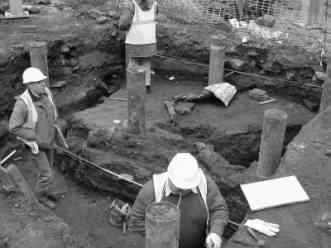
Recent developer funded excavations on the Skinnergate in Perth located up to 14 separate floor levels overlying each other to formation level. The pottery assemblage recovered from these deposits implies that there may be as little as 150 years between the highest and lowest floors, this has interesting implications for the level of renewal of timber buildings in the medieval burgh. This site has also produced yet another fragment of North German stove tile dating to the 15th or 16th centuries.

Redware Sourcing

Historic Scotland have now commissioned this follow on to the redware pilot study of 1997 and the project members are in the process of collecting brick, tile, pottery and clay samples.

Perth High Street Excavation

SUAT Ltd have been commissioned by Historic Scotland to manage the post-excavation programme on the late Nicholas Bogdan’s excavations to completion. As part of this all the imported pottery will be laid out for a specialist seminar in September or October of this year.

Scottish contact

No. 48 – April 2004

Secretary’s Notes

Council met on 20th January at the Society of Antiquaries in London. Top of the agenda was a forward strategy for the group. As a starting point for discussion, the President circulated an outline document, taking as its starting point Medieval Ceramic Studies in England (1994). On a more specific note, Council discussed ways in which MPRG could have input into the current EH-led initiative to produce regional research guidelines. One region (East Anglia) has already published a research agenda; other regions are in various stages of consultation or resource assessment. It would be desirable to get representation on to the various steering groups if we want direct input into these projects. Access to information is the key – we need to stress that HERs should contain proper records of finds and environmental data, and require indices so that researchers can find key sites, findspots, etc. So much ceramic work is currently published only in grey literature. Digital data is also of increasing importance – in the future, HERs will be attaching site archives (including digital data) to their records.

Volume 25 of Medieval Ceramics will be out shortly. This volume has received over 50% funding through various grants (which will be fully acknowledged in the volume). Volume 26, which will carry papers from the Irish conference in 2002, is also well advanced, and sufficient papers have already been received for Volume 27, which will include the Scottish White Gritty Wares report. The Editorial Committee’s aim to seek a higher level of funding for these and future volumes will enable us to build up reserves which could be used, for example, for digital publishing projects.

The provisional programme and booking form for this year’s annual conference in Winchester are circulated with this newsletter, together with agenda and reports for the AGM which will be held at the conference. We hope to see as many members as possible there, for what promises to be a very stimulating conference. It is hoped that next year’s conference, which will be a one-day event, will be held at the Ashmolean Museum in Oxford. Some members may also be planning to attend the EAA conference to be held in Lyons in September, where MPRG will be represented in order to discuss the European Production Centres Project.

The next Council meeting will be held during the Winchester conference.

Lorraine Mepham, Secretary


Database of European Production Centres

The proposal for a round table at this years EAA conference in Lyons has now been accepted by the scientific committee. With this in mind I have created a group e-mail list in order to keep all interested parties up to speed. If anyone has not registered an interest in this project with me could they please do so.

Derek Hall, Assistant Secretary


Regional Research Frameworks

The development of regional research frameworks is being encouraged, and in part funded, by English Heritage in an attempt to close the gap between research/academic archaeology and PPG16 led fieldwork. These are local initiatives influenced by local archaeologists and will have an effect on future work. The best way to make sure that a ceramic research agenda is included in the framework for your region is to participate in the meetings. The first stage is the resource assessment (what do we have and what are the problems and potential of the resource) followed by the compilation of the research frameworks. This is the state of play as of February.

  1. East Anglia – Published and now undergoing a revision
  2. West Midlands – The resource assessment is almost finished with many papers on-line but further meetings will be held in 2005
  3. East Midlands – About half way through the resource assessment stage
  4. North West – About 9 months into the resource assessment
  5. London – Completed
  6. Kent – Submitted proposal
  7. South West – At project design stage
  8. North East – At project design stage

Having been involved in the West Midlands Regional Research Frameworks I would encourage any one who isn’t already to get involved.

Victoria Bryant MA MIFA, Historic Environment Record Manager, Worcestershire County Council Historic Environment and Archaeology Service, Woodbury Hall, University College Worcester, Henwick Grove, Worcester WR2 6AJ, tel 01905 855494


MPRG Bibliography

Now that the decision has been taken to no longer publish a bibliography in Medieval Ceramics but to concentrate on an online version can I direct members to http://ntserver002.liv.ac.uk/mprg/ where they will find this excellent resource.


In Memory of John Hurst

The editors would like to invite any member of MPRG to contribute towards compiling a fitting tribute to John in the next journal. This will be published in the spring of 2005. As well as formal obituaries it would be nice to include shorter contributions from anybody who feels they would like to comment on their association with John, either as a work/pottery colleague, travelling companion or simply for his friendship.

Please send any submissions or photographs you may have to; The Editors, MPRG c/o MOLSS Mortimer Wheeler House, London, N1 7ED by 1st September 2004.


Subscriptions

Can those of you who have not yet paid your subscriptions for 2004 please do so? Any queries please contact Nigel Jeffries


Historical Archaeology Conference: Continuity and Change

York, 5-10 January 2005

We have a dedicated conference webpage or via University of York webspace.


Regional Group Reports

Scottish Group

Sourcing Scottish White Gritty Ware

The first draft report on this project has now been submitted to Historic Scotland, with the intention of publication in Medieval Ceramics and SAIR (Scottish Archaeological Internet Reports). As part of this project Dr Richard Jones and his students carried out further geophysical survey of the unscheduled and uncultivated field directly adjacent to the excavated kilns at Colstoun.

Proposed Seminar

The Scottish Group is holding a seminar on 30th April in Customs House, Leith with the main focus of discussion being the continuing plough damage at the Colstoun production centre. Progress on the New Review of pottery imported into Medieval Scotland will also be discussed. There are still spaces available for this please contact me if you are interested in attending.

Lustreware
Malagan Lustreware from Horsecross, Perth

Excavations at Horsecross, Perth

The initial spot dating of the large assemblage from the Horsecross excavation has just been completed. It contains the first examples of an 11th/12th century fabric which is also found in Lincolnshire (pers comm A Vince) and some rare examples of late medieval imported wares from Iberia and Green Glazed stonewares from Siegburg in Germany. D Hall can also confirm that it has also produced several pieces of kiln furniture, the potters are out here somewhere on the northern limits of Perth!

Scottish contact


Computer Based Methodologies for Pottery Analysis

English Heritage is funding the development of a flexible database system for the cataloguing, dissemination and archiving of archaeological data. On completion of the project, it is intended that the system will be made freely available to other archaeologists. The pilot scheme at the McDonald Institute for Archaeological Research, Cambridge, is being implemented by Phil Mills through a study the Romano-British pottery assemblage from Hayton, East Yorkshire, under the direction of Prof Martin Millett and Dr Jerry Evans. It is intended that the database will be developed to become as useful for ceramics of any period, for small finds and even animal bones.

The development team are well aware that to make the most of the technology it is important that implement strategies are discussed among likely users. They duly organised a one-day conference to explain and demonstrate how the system is being developed and requesting and encouraging feedback from delegates in order to improve the database. On Saturday 24th April 2004, Anna Slowikowski and I were among twenty delegates at the meeting held.at the McDonald Institute.

The title, ‘Digital archiving for the pottery specialist made easy’ held a clue to the hidden agenda, the wish that users would in the fullness of time, deposit their archives with the Archaeology Data Service (ADS), and in the morning, as well as useful introductions by Millett, Evans and Mills, we had the sales pitch from the ADS rep. Apart, of course, from lunch and the networking opportunities, the ‘best bit’ was in the afternoon, a 90-minute workshop, a hands-on session playing with the database and offering our criticisms. This was followed by more than enough time in seminar for feed back between the delegates.

The system allows linking to context information, and to in-house and regional or national fabric and form ‘type’ series. It incorporates software for analysis as well as for data entry. It is intended to be used alongside excel and word to produce report ready tables and graphs. It can produce drawing lists. In my opinion, the system is already readily adaptable for use at multi-period sites, and I am joining the queue to get a copy as soon as possible.

Our meetings Secretary is endeavouring to get at least a demonstration of the system at the MPRG annual conference in Winchester in June. A report on the project is to be given at the Roman Pottery Research Group conference on 3rd-5th July 2004.

Katherine Barclay


An Unusual Medieval Floor Tile From Chester

Chester tile

A somewhat worn medieval floor tile excavated by Chester Archaeology from the nave of Chester Cathedral is on display alongside ancient silks and T’ang ceramics in a major exhibition at the British Library. The tile is one of several hundred exhibits which have been loaned by museums in China, Japan, India, France, Germany and the United Kingdom for ‘The Silk Road: Trade, Travel, War and Faith’. The exhibition explores the history, cultures and everyday life of the ancient route through central Asia. The floor tile was made in Cheshire but the reason for its inclusion in the exhibition is its design of three hares linked by their ears so that whilst only three ears have been drawn each hare has two ears (see Figure).

This motif also appears in wall paintings dating from the seventh century found in the elaborately decorated Caves of a Thousand Buddhas at Dunhuang, north-west China. These caves were used as shrines where merchants would go to pray before setting off on their long journeys. It has been suggested that the motif travelled along the Silk Road eventually appearing in northern Europe in the fourteenth/fifteenth century. The design appears on a relatively small number of tiles found in Chester and there is only one complete example from the city; the same motif but in a different design also appears on a tile from Long Crendon, Oxfordshire. A group of researchers (The Three Hares Project) have been recording objects and buildings where the three hares occur in an effort to prove the origins of the design. The exhibition runs from 7th May to 12th September 2004.

Julie Edwards

No. 47 – January 2004

Secretary’s Notes

Council met on 15th October at the Society of Antiquaries in London. The Editorial Committee once again reported good progress, both with the publication of forthcoming volumes of Medieval Ceramics and also with the receipt of various grants towards publication, including a grant from the Marc Fitch Fund toward Volume 25. This should be out early in the New Year. The next two volumes will feature, respectively, the papers from the Irish conference in 2002 and, it is hoped, a report on Scottish White Gritty Wares.

The group still holds a substantial quantity of back numbers of MC. In order to shift this stock, and to raise further funds for the Group, Council have decided to offer these to members at reduced prices – details appear elsewhere in this Newsletter.

Discussions continue over the Bibliography. Although only one response was received following the note in the last newsletter asking for members’ views, it was decided that we will no longer produce a published version of the Bibliography, but we will still support the collection of data for the on-line version.

Alongside as our immediate concerns, the President directed our thoughts towards future strategy. There is currently an EH-led initiative to produce regional guidelines in an attempt to put research back into developer-funded fieldwork. We feel that MPRG should be involved in such a process. However, if we are to produce anything, it must be something short, snappy and focused that curators can use easily. Starting points could be Maureen Mellor’s 1994 Survey, our submission to APPAG, and Alejandra Gutierrez’s recent questionnaire on teaching and research in higher education. We could, for example, push for decent indices of ceramic work to be incorporated into revamped SMRs/HERs, as there is now government money available for upgrading these.

Council again discussed ways of commemorating John Hurst through the work of the Group. A few replies were received after the invitation for suggestions in the last newsletter – a travel fund and a research fund for students were suggested. Council thought a memorial lecture was the easiest option, and that a ‘general research fund’ in John’s memory could cover several options.

In February 2003, MPRG was approached by a Hungarian archaeologist mooting the idea of European project on production centres. This was followed up at a round table discussion at EAA conference in St Petersburg, attended byDerek Hall and Maureen Mellor. It was suggested that MPRG might like to promote such a project, involving setting up a database for European production centres. Preliminary discussions have already been held with King Alfred’s College, who currently hold the database of production centres in England, and with EH. Part of the project would be to put the resulting database on-line. Derek Hall gives further details of this project below.

You will receive with this newsletter the preliminary publicity for next year’s annual conference – a three day event in Winchester on the subject of Transformation. Further details and booking forms will be available with the next Newsletter in April.

The next Council meeting will be held on Tuesday 20th January.

Lorraine Mepham, Secretary


Back Copies of Medieval Ceramics

Ever felt that there was something missing from your bookshelf? Why not remedy this straight away by looking at what copies of Medieval Ceramics are still available at £5 each – or why not buy 10 and get one free?

As you can see there are complete runs from Volume 11, and earlier numbers might be able to be scanned at extra cost. All requests for back numbers should initially be sent to Nigel Jeffries, Membership Secretary.


Database of medieval pottery production centres in England: a new resource for archaeology

Among the principal recommendations arising from the English Heritage review Medieval Ceramic Studies in England was the need for ‘an initiative to establish a national list of production centres, recording the whereabouts of the finds, references to publication, or the current state of work’ (Mellor 1994, 32). Behind this recommendation lay widely-expressed concerns within the profession about the disappointing rate of publication of excavated production sites and the desire to improve identification and common nomenclatures for medieval pottery in order to avoid inconsistencies in reporting. It was felt a new national database could help to address these concerns and provide a basis for further technical studies of kilns, as well as informing cost-effective research and raising awareness of the importance of production centres generally.

Between May 1997 and June 2000 a project was established at King Alfred’s College, Winchester which was designed to address these issues. The project was designed and managed by Chris Gerrard, undertaken by Phil Marter and funded by English Heritage. The procedure was simple. Information held on medieval pottery production sites (defined here as c850-1600 AD) in England was obtained from the National Monument Record Long-listings and Excavation Index and from county Sites and Monuments Records, 70% of whom responded to requests for information. To these two sources were added data collated by the Medieval Ceramics Survey and that stored with the National Reference Collection of Medieval Ceramics at the British Museum. Major published national and regional data sets such as McCarthy and Brooks (1991), Musty (1969), Vince (1984), Victoria County Histories and published documentary sources (Lay Subsidy ‘potting-related’ names, for example) were also input, as well as information from local and national journals such as Medieval Archaeology and Medieval Ceramics. An advance digital copy of the thin-sections database allowed descriptions of thin-sections from pottery fragments found at kiln sites to be linked in. About half of the forty-five county museums targeted responded to a request for accession numbers for their holdings. These sources, nearly 1500 in all, were then cross-checked against the National Medieval Ceramics bibliography to verify a master database of some 4500 entries which was circulated to regional secretaries of the Medieval Pottery Research Group for further checking.

The key to the success of the project has been to design and manage a series of linked tables within a Microsoft Access database. This allows the researcher easily to interrogate the information held within the database. The database contains records of archaeological investigations or events (eg excavations), kilns, components (eg waster dumps), pottery fabrics, forms (standardised using the Classification of Medieval Pottery Forms; MPRG 1998) and sources (eg article reference). The relational structure of the database allows the researcher to interrogate the data in various ways such as looking for pottery kilns by county, by date, and so on. There are 738 kilns recorded on the database, 97 waster pits, 80 buildings interpreted as potters’ workshops or living accommodation, as well as a wide range of associated features such as clay pits, puddling floors, fuel dumps, fences, drains and boundary ditches. Unsurprisingly, there has been strong bias in favour of recording kilns, which comprise 60% of all the recorded elements from medieval pottery production centres in England. Neither is the work evenly spread, some counties like Lincolnshire, Norfolk and Yorkshire having strong track records of excavation and wider synthetic research, others such as Cheshire, Cambridgeshire, Durham, Lancashire and Warwickshire being far less well represented. The bibliography confirms that much of the recent work has been undertaken by a small pool of active researchers, with a notable lack of recent academic research into medieval pottery production being undertaken through universities and MPhil and PhD levels. Very few recent theses were identified in the course of this project, the weight of publication strongly favouring short descriptive articles rather than broader scale analysis of results. It is a sign of the times that the basis of modern research into kiln classification remains Musty (1974) and that, with some notable exceptions (Le Patourel 1968; Moorhouse 1983), documentary evidence for the medieval pottery industry remains untapped.

Between November 2002 and March 2003 the format of the database was finalised and is now equipped with an ‘easy-to-use’ front end complete with a selection of regularly used data queries and a help file. The data will be made available free of charge on CD to all those who originally supplied information to the project. For anyone else who would like a copy, the database is available at cost on CD and in hard copy (price per page), plus postage and packing from Phil Marter, King Alfred’s College, Winchester SO22 4NR. For anyone wanting more information, a website explaining the project and giving examples of the data available can be found online. For the next three years, until March 2006, the database will be maintained by Phil Marter and anyone willing to update or make corrections to particular entries will be able to do so by passing new information directly to him. In March 2006 the responsibility for the upkeep of the database will pass to the Medieval Pottery Research Group.

Le Patourel, J, 1968. Documentary evidence and the medieval pottery industry, Medieval Archaeol 12, 101-126

MPRG (Medieval Pottery Research Group) 1998. A Guide to the classification of medieval ceramic forms. MPRG Occasional Paper 1. London; Medieval Pottery Research Group

Mellor, M, 1994. Medieval Ceramic Studies in England. A review for English Heritage. London; English Heritage

Moorhouse, S, 1983. Documentary evidence and its potential for understanding the inland movement of medieval pottery, Medieval Ceramics 7, 45-87

Musty, J, 1974. Medieval pottery kilns, in VI Evison, H Hodges and JG Hurst (eds), Medieval pottery from excavations: studies presented to Gerald Clough Dunning, with a bibliography of his works, 41-67. London: J Baker

C Gerrard and P Marter


Database of European Production Centres

Following a round table session at last years EAA conference in St Petersburg it was decided to take forward Zsolt Vagner’s suggestion of a European database along similar lines to the one described by Chris Gerrard and Phil Marter above. For this to work successfully we need several European partners with a view to submitting a bid to Culture 2000 later this year. It is our intention to have a day session on this subject at this year’s EAA conference in Lyons in September. I would like to ask anybody who might be interested in becoming part of this potentially exciting project to contact me in the first place so that I can register their interest.

Derek Hall, Assistant Secretary


Regional Group Reports

Scottish Group

Stove Tile (B&W)
Stove Tile from St Giles Cathedral, Edinburgh (© SUAT Ltd)

Stove Tiles

Fragments from these high status central heating systems were very rare finds in Scotland until recently when several have been recovered from excavations in Edinburgh, St Andrews and Perth. The example from St Giles Cathedral in Edinburgh appears to be from a chained unicorn, the jury is still out as to whether this might be a fragment from the Scottish Royal Coat of Arms.

Scottish Redware Sourcing

It is hoped to start this ICPS project in the new financial year and as part of it the participants would like to include samples from redware brick and tile works. If anyone has or knows of a collection of named Scottish bricks could they contact either Derek Hall or George Haggarty.

Can I ask for more regional group reports from people please? I know that we are busy little bees up here but I am sure that some of you are as well.

Scottish contact

No. 43 – August 2002

Secretary’s Notes

The Group’s AGM was held in London as part of the one-day meeting on May 18th. Reports had been circulated beforehand, and discussion centred around the Group’s financial situation, and the potential effects of this on the future production of Medieval Ceramics. It has become apparent that the Group’s finances are not as healthy as they appear, since much of our current balance consists of income from sales of the Guide which, according to the conditions of the original English Heritage grant, cannot be used for anything except further publications within the Occasional Paper series. This has the obvious effect of limiting the resources available for publishing Medieval Ceramics, for which the two volumes (24 and 25) are currently going through the editorial process. Increasing the Group’s income has therefore become crucial, and Council has been discussing the possibility of a rise in subscription rates. Council proposed a rise from the current rate of £10/£13 to £15/£20, but the ensuing debate resulted in the proposal of a higher rate, of £20/£25, to take effect from February 2003.

Council pursued the raising of funds as a matter of urgency at the Council meeting held in London on June 20th, and are currently following up some of the options suggested, as well as ways of reducing costs for the distribution of Newsletters and journals. One cost reducing measure would be the electronic distribution of the Newsletter (see the appeal for email addresses below). In the meantime, it is still hoped to produce Volume 24 of Medieval Ceramics within the current subscription year, although publication of Volume 25 may have to wait until next year’s subscriptions are in.

To finish on a more positive note, Council would like to extend their thanks, and those of the Group, to our retiring President, Clive Orton who, it is hoped, will now have more time to pursue his multifarious research projects. Thanks also to Bob Will (Treasurer) and Sue Anderson (Assistant Secretary), both retiring but very kindly still filling their respective posts until replacements can be found; and to Alejandra Gutierrez (Ordinary Member). We are delighted to welcome to Council our new President, Maureen Mellor, who despite taking over the reins at a somewhat difficult time has already proved herself equal to the task, and a new (but very familiar!) Ordinary Member, Barbara Hurman. In addition, Council has decided to create a new Council post of Membership Secretary, to ease the Treasurer’s burden, and has co-opted Nigel Jeffries to the post.

We look forward to seeing as many members as can make it in Dublin for the long-anticipated conference (details on the MPRG website). The next Council meeting will be held on 15th October; if you have any comments or wish to raise any issues, please contact me before then. Ideas on fund-raising would be especially welcome.

Lorraine Mepham, Secretary


MPRG Change of Address

Please note that the MPRG now has a new address for general correspondance. Museum of London Specialist Services has offered to host the group, as several of the staff are currently on the MPRG Committee. Council would like to thank David Barker and his colleagues at Stoke-on-Trent for the use of their address over the past few years.


New Membership Secretary

At the last council meeting it was decided that Nigel Jeffries would be co-opted to the new Council position of Membership Secretary. His position will be ratified at the next AGM. Previously the task of Secretary was undertaken by the Treasurer but it was felt that these tasks should be separate, in keeping with the structure of most other Societies and Groups.

Nigel now has a full copy of the membership database and would like initially to stress that changes of address can be directed via the website. Over the coming months Nigel will be cleaning and updating the database and may be in contact with members whose details appear incomplete.

If members have had any problems with mailing or have recently changed address then please do not hesitate to contact him by email (via the website), post (by using the Group’s new address) or telephone (020 7566 9312). He is particularly keen in gaining the email address of membership (see below).

Nigel Jeffries
Museum of London Specialist Services
Tel: 020 7566 9312
Fax: 020 7490 3955


Electronic Newsletter and Email Addresses

In order to reduce the costs of distributing the Newsletter, we are planning to circulate it electronically to as many members as possible who are on-line. If you have an email address, therefore, and do not object to receiving your Newsletter by this means, please send the details to our new Membership Secretary, Nigel Jeffries.


Meetings and Conferences

Medieval Europe 2002

10th-15th September, Basel, Switzerland

The theme of next year’s conference is ‘Centre – Region – Periphery’. There are eight themes, which are as follows:

  • Cultural regions, economic areas
  • Innovation, communication, interaction
  • Sovereignty and territory
  • Structure and topography of the ruling power: Identity and demarcation
  • Settlement in inhospitable regions
  • The Regio TriRhena
  • New studies of medieval and later archaeology in Europe (poster session)

The detailed programme and the (final) registration forms will be sent out in Autumn 2001 to all who have enrolled by 1st October 2001 via email, fax or post. Contact Medieval Europe Basel 2002, c/o Archaeologische Bodenforschung, Petersgraben 11, PO Box CH-4001 Basel, Switzerland. Fax +41-61-267 23 76, web www.mebs-2002.org.

Changing beliefs: aspects of conversion in the early medieval period

12th October, Sutton Hoo

The Sutton Hoo Society is holding a conference where speakers will address various aspects of landscape, religion, politics and culture associated with the Pagan/Christian interface in the Anglo-Saxon period. Details and application forms from The Sutton Hoo Society, c/o Tranmer House, Sutton Hoo, Woodbridge, Suffolk IP12 3DJ (please enclose SAE).

Prehistoric pottery: people, pattern and purpose

12th-13th October, Bradford

The Prehistoric Ceramics Research Group and the Ceramic Petrology Group will be holding a joint conference entitled Prehistoric Pottery: People, Pattern and Purpose. at the University of Bradford. The conference is open to all. Further details are available from Alex Gibson, Chairman PCRG, Department of Archaeological Sciences, University of Bradford, BD7 1DP.

Potweb Meetings: Autumn Lecture Series

Ashmolean, Oxford

One of the world’s finest collections of ceramics – from East to West, from pre-historic to C20th – is held here at Ashmolean Museum in Oxford. PotWeb is an ambitious project to catalogue the collection online, bringing together the fruits of 150 years of historical and archaeological research. This series of lectures, given by a distinguished group of speakers, is in support of the project. Each lecture is at 2.30pm in the Headley Lecture Theatre, admission is free.

  • Oct 13th Ancient Greek Pottery – Prof John Boardman
  • Oct 27th English Country Pottery – Dr Peter Brears
  • Nov 10th German Stoneware – Dr David Gaimster
  • Nov 24th French Porcelain – Dr Aileen Dawson
  • Dec 8th Lustre ware – Alan Caiger-Smith

For further information, or to reserve tickets, tel 01865 288073.

Finds Research Group 700-1700: Fairs and markets

19th-20th October, Edinburgh

The autumn 2002 meeting of the Finds Research Group 700-1700 will be hosted by Dr David Caldwell at The National Museums of Scotland, Edinburgh. There will be guided tours of the Museum and the chance to explore Edinburgh on Sunday. Further details from Jenny Shiels or Jackie Moran, Medieval Department, National Museums of Scotland, Chambers Street, Edinburgh EH1 1JF, tel 0131 247 4082, fax 0131 247 4060.

Kakiemon and its Influence on Continental and English Porcelain

2nd November, Oxford

A day school from 10.00am-4.00pm, Ashmolean, Oxford. Cost £35 (£30 Friends of the Ashmolean, £20 Full-time students), includes lunch and a glass of wine. This second Day of Special Interest focuses on the influences of Kakiemon porcelain across cultures. Lectures by expert Oliver Impey, Aileen Dawson and Simon Spero.


Courses

The Making and Using of Medieval Pottery

A practical archaeology weekend will be held on 23rd-24th November 2002 at the Department of Continuing Education in Oxford, led by Maureen Mellor and Jim Keeling (master potter).

For the medieval period, huge quantities of pottery survive for the archaeological record. Form and decoration change. What stimulated the European potters? This course is designed for students who want to experience at first hand the processes involved in the making and decorating of post-Roman pottery vessels. We will explore the influences on the potter craftsmen and set these vessels in their historic environment. The course will culminate in an experimental firing. Numbers on this course will be limited to 24. Early application is strongly advised.

For further details, contact Department for Continuing Education, University of Oxford, Rewley House, 1 Wellington Square, Oxford OX1 2JA, tel 01865 270360, fax 01865 270309, web www.conted.ox.ac.uk.


Help

I am writing in the hope that MPRG members might be of assistance in identifying some peculiar pottery found at Ferryland, Newfoundland. The fabric is micaceous, the bases hand-formed and “sagging” or convex. The peculiar inverted lip may have been designed to prevent spilling or slopping while cooking at sea. We believe that the pots date from the early sixteenth century, but at Ferryland anything is possible. Thank you in advance for your trouble. I look forward to hearing from you. Jim Tuck.

Ferryland Pot Rim And Lug     Ferryland Pot     Ferryland Pot Drawing

No. 46 – September 2003

Secretary’s Notes

Council met on 17th June at the Society of Antiquaries in Piccadilly. Much of the meeting was taken up with editorial business and our recent fund-raising efforts. We also discussed the Bibliography.

Volume 25 of Medieval Ceramics will now appear in the autumn, delayed for John Hurst’s obituary. Volume 26, containing the papers from the Dublin conference, is in preparation, in the capable hands of Clare McCutcheon, and some papers have already been received for Volume 27.

Peter Davey attended the Council meeting to discuss the Bibliography. The online version is curated (at no cost to MPRG) at Liverpool University, and is updated from the Annual Bibliography (about 350 entries every year). The online version also contains a large amount of backlog material (not published in Medieval Ceramics), resulting from volunteers covering whole back-runs of journals, but geographical coverage is uneven. Following the departure of Liz Pieksma, the Annual Bibliography now lacks a co-ordinator. Despite problems, pointed out by Peter Davey, of inconsistent nomenclature, which make it impossible to index the Bibliography satisfactorily for research purposes, all were agreed that the Bibliography is potentially an immensely useful tool. This subject is addressed later on in this newsletter.

The annual meeting on Nottingham in June, organised by Duncan Brown, was very successful – speakers presented a range of stimulating papers on the subject of technology, and the event attracted a number of non-members. Next year’s annual conference will be a three-day event in Winchester on the subject of Change – preliminary details appear elsewhere in this Newsletter.

The Membership Secretary and Treasurer have continued to chase up subscriptions, and are now targeting institutional members. Overseas members are reminded that MPRG now has both euro and dollar accounts, enabling easier payment.

Enclosed with this newsletter is a copy of our very attractive new publicity leaflet. If you can, please display it in a prominent place. This is part of our drive to attract new members.

Our recent problems with our website host have happily now been resolved, thanks to Sue Anderson, and we are now back on-line. Both Sue and Council are looking at ways to improve the website, and would welcome any suggestions (more links to related websites, etc) – please pass on any ideas in the first instance to Victoria Bryant.

The next Council meeting will be held on 15th October; if you have any comments or wish to raise any issues, please contact me before then.

Lorraine Mepham, Secretary


Dear Members

Your views are sought on two important subjects currently under discussion by Council. Please think about these and pass on any thoughts to Derek Hall.

John Hurst

Council decided at their last meeting that they would like to ask the views of the membership on the best way of commemorating the life and work of John Hurst. One way might be to have a memorial lecture at the MPRG conference in a similar fashion to the current Gerald Dunning lecture. Maybe we could alternate between a Gerald Dunning lecture and a John Hurst one? Several members have suggested setting up a travel fund in John’s name to allow people to travel abroad to conferences or to search for parallel material. Could I ask members to let me know what they would prefer?

MPRG Bibliography

As mentioned earlier on in the Secretary’s notes the time has come for the membership to decide how they would like the Bibliography to proceed. If we were no longer to publish it in Medieval Ceramics but to rely on it as an online internet resource would people miss it? In short is there any need to publish both in print and online? Can I ask for your views on this please.

Derek Hall, Assistant Secretary


MPRG Annual Conference 2004

Call for Papers

The theme of the conference is ‘Looking at Change’ – we’ll be considering how we identify and interpret changes in the ways pottery was produced, supplied and used, and indeed examining how medieval pottery developed. We’ll also look at how our methods for studying the ceramic record have progressed; and of course, we will be discussing what all those changes might mean.

Any offers of papers should be sent, with their name, contact details, and a draft title with brief description, to: Duncan H Brown, 7 Donnington Grove, Southampton, SO14 1RW.


Conference

A ‘beautiful and ingenious’ art: a one-day conference on Spanish and Italian lustreware

11th March 2004, The Wallace Collection, Hertford House, Manchester Square, London W1U 3BN

This fascinating conference will address some of the most intriguing aspects of lustreware, from the challenge of producing it to questions of attribution and inspiration. From the Renaissance and the Renaissance Revival to the experience of potters working with lustre today, this conference will provide participants with the opportunity to find out about recent research from experts in the field and to enjoy a visual feast of lustrewares both on screen and in the galleries of the Wallace Collection.

Speakers will include Giulio Busti (Director of the Museo Regionale della Ceramica, Deruta), Alan Caiger-Smith (practising potter), John Mallet (formerly of the Victoria & Albert Museum), Anthony Ray (publications include Spanish Pottery 1248-1898), Dora Thornton (British Museum), Jeremy Warren (Wallace Collection), Steve Wharton (completing a doctoral thesis) and Timothy Wilson (Ashmolean Museum).

Conference fee £35 per person; concessions £25. Advance booking is essential. Payment is by cheque only. Contact Hayley Kruger, The Wallace Collection, tel 020 7563 9551.


Regional Group Reports

Scottish Group

Survey of Coulston
2003 survey of Colstoun production centre (© University of Glasgow)

Plough damage at Colstoun

A recent geophysical survey at Colstoun as part of the Sourcing Scottish White Gritty Ware project suggests that there has been considerable damage to the site since the last survey of 1999. It is intended to submit a bid to the Historic Scotland archaeology programme to assess how bad this damage is and decide what form of mitigation should be adopted.

Kinlochbervie shipwreck

Members of the group were given the opportunity, by Duncan Brown and Celia Curnow, to view the most recent group of ceramics from this shipwreck. A much larger group of oil jars and tiles was recovered than from the previous season as well as a smaller group of Maoilica.

New Review of imported ceramics

It is planned that Volume 1 of this review will be published by the City of Edinburgh Council early in 2004. This will focus on a catalogue and review of imported wares from France, Spain and Italy.

EAA conference, St Petersburg, Russia

Derek Hall attended this conference and gave a paper on the Scottish Medieval Pottery Industry to a mixed audience of Dutch, French, Russian. Macedonian and English delegates! One potentially important thing to come out of the ceramic session is the plan to create a database of European Ceramic Production Centres. This idea has been given EAA backing and will be discussed at the next MPRG council meeting.

Scottish contact

Navigation